Turn your data center into a grid-supporting asset.
Bluefin's patented ULN generation platform brings fuel-secured, dispatchable behind the meter generation — helping data centers maintain operations while reducing grid demand when it matters.
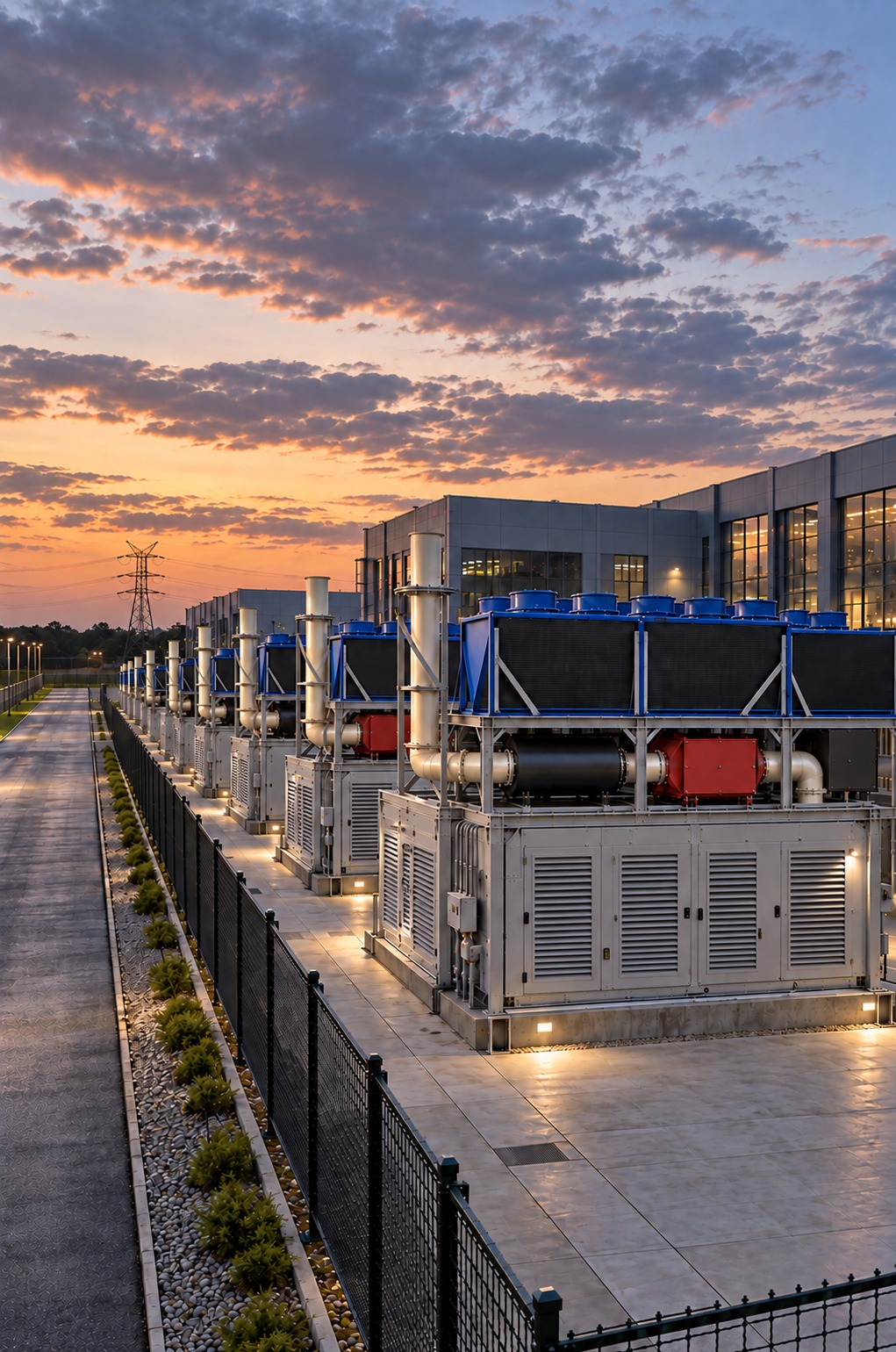
Large-load growth can move faster than the grid infrastructure built to serve it.
Data center campuses are being planned and built on timelines set by demand, while the transmission and generation capacity to serve new large loads is developed on its own schedule. Where and when that gap matters is specific to each utility, service territory, and interconnection queue — it isn't universal, and it isn't static.
Flexible demand, supported by on-site generation, is one option worth evaluating on a project-by-project basis: a way to keep a campus moving forward while utility infrastructure catches up, and a way for utilities to accommodate large loads without committing every new customer to firm, uninterrupted service from day one.
Framed this way, a campus stops being simply another large load competing for capacity — it becomes a participant in managing it.
Three outcomes, one platform
Behind-the-meter generation designed to work with a campus's electrical system and a utility's operating agreements — not around them.
Maintain critical operations
Appropriately configured on-site generation is designed to keep designated critical loads running through a utility interruption, using equipment and controls sized to the campus.
For data center teams →Reduce grid demand during constrained periods
Coordinated curtailment lets a campus shift designated loads onto on-site generation, reducing utility imports during periods the utility and customer agree on in advance — often the same peak hours that drive costs shared across the broader ratepayer base.
For utilities →Evaluate flexible utility service
Where permitted, customer-sited dispatchability can support interruptible or non-firm service arrangements — an option to evaluate alongside standard firm interconnection.
See the platform →Three operating states, one electrical system
The same on-site generation and controls can be configured for different roles depending on grid conditions. Which states apply — and how they're triggered — depends on electrical design, controls, permits, and the utility agreements in place for a given site.
Utility power serves the campus under normal conditions. On-site generation remains available but is not dispatched.
On-site generation serves designated campus loads on a coordinated basis, reducing the campus's utility imports during the periods the customer and utility agree on.
During a utility interruption, behind the meter on-site generation supports uninterrupted operation.
Illustrative diagram. Actual operating states, triggers, and load coverage depend on each site's electrical design, protective relaying, controls programming, permits, and utility interconnection agreement.
Generation, emissions control, fuel, and integration — as one system.
ULN pairs a medium-speed diesel generation package with an engineered emissions-control architecture, on-site fuel storage, and the electrical integration a data center campus needs to put it to work. The platform is built around operating and maintenance practices that are already familiar to diesel generation operators.
View platform architectureGeneration
Medium-speed diesel generation package, sized for prime-rated dispatchable operation and backup duty depending on equipment configuration and applicable approvals.
Emissions control
Engine-level NOx reduction paired with downstream low-temperature selective catalytic reduction (SCR) using aqueous ammonia.
Fuel
On-site liquid fuel storage supports dispatchability independent of continuous pipeline delivery. Runtime is a function of tank capacity, load, and a replenishment plan — not unlimited.
Integration
Controls and switchgear tie the platform into campus electrical systems and, where applicable, utility coordination requirements.
Built for three audiences, one conversation
Owners, operators & developers
Address utility power constraints, continuity of critical operations, campus expansion, and operational familiarity — with a path to accommodate utility curtailment requirements through on-site generation.
Discuss Your CampusUtilities, cooperatives & grid stakeholders
Controllable customer demand, coordinated curtailment, and customer-sited dispatchability that can help accommodate large loads while infrastructure is developed.
Explore Grid SupportEngineering & infrastructure partners
A clear introduction to the architecture, integration considerations, and how to request technical information for evaluation.
Request a Technical BriefA data center that gives back to the grid, breathes cleaner, and doesn't draw down water.
The conversation around new large loads tends to start from a deficit: another draw on a system that's already stretched. A campus with coordinated, on-site ULN generation changes that starting point on three fronts at once.
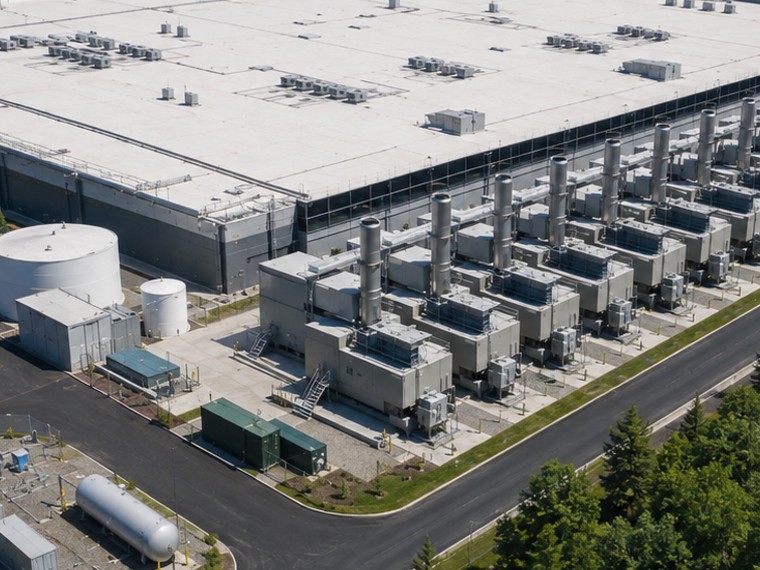 Representative campus — illustrative, not a Bluefin project photo
Grid-supporting, not grid-straining
Coordinated curtailment lets a campus shift its own draw onto on-site generation during exactly the hours that matter most to the grid — the same peak hours that drive a meaningful share of the system and transmission costs shared across the full ratepayer base.
Ultra-clean emissions, engineered in
Engine-level NOx reduction paired with low-temperature SCR brings NOx output to sub-1 ppm — below the equivalent NOx emissions of a comparable natural gas reciprocating engine, and the performance the "Ultra-Low NOx" name refers to.
Air-cooled — no water drawn down
The generation package is cooled by ambient air across its radiator and fan section, not a wet cooling tower or evaporative process. Coordinated curtailment events run without competing with the community for water the way some other generation technologies do.
Grid & ratepayer relief
A large share of what shows up in electricity rates is driven by a small number of system and transmission peak hours each year — costs that get shared across the full ratepayer base, not just large customers. A campus that shifts its own draw onto on-site generation during those specific hours is reducing the load that sets those costs, rather than adding to it. The actual rate impact depends on each utility's cost allocation and tariff design — Bluefin doesn't set or guarantee that outcome — but it's the real mechanism behind treating this kind of customer-sited generation as a grid-supporting asset rather than a grid cost.
Emissions performance
Engine-level reduction and low-temperature SCR together bring NOx output to sub-1 ppm — below the equivalent NOx emissions of a comparable natural gas reciprocating engine. See the platform specifications for the full picture.
Water
The ULN platform's generation package is air-cooled by design — cooled across its own radiator and fan section rather than a wet cooling tower or evaporative process. That means normal operation, including coordinated curtailment events, doesn't draw on local water supply the way some water-cooled generation technologies do. This describes the generation package itself; a campus's IT cooling systems are a separate part of its overall water profile.
Acoustic design
Enclosure and siting decisions account for the campus's surroundings. Site-specific sound levels depend on enclosure configuration, siting, and any additional attenuation — figures are provided per project once confirmed.
Community compatibility
Reliable power for the campus and continued reliability for the surrounding grid are the same objective, not competing ones — which is the basis for how ULN projects are sited, screened, and operated.